

I write today from a place of warmth and gratitude, knowing that I have once again awoken in what many illustrious persons regard as the greatest city in the world, New York City. While one could debate the individual flaws or merits attached to this claim, I, as a citizen of the great Gotham, most readily agree with this well-favored statement.
Despite any argument made against New York, one must admit there is never a want for pleasure, nor a lack of establishments in which to fulfill such desires. In fact, some might contend that, whether through wealth, the arts, or the kind of indulgence better attended to after dark, New York City has long succeeded in providing an outlet for each and every one.
But in a time before Tinder, Reddit, or Yelp reviews, where might a respectable person find and procure that particular horizontal refreshment? Where might they partake of the forbidden fruit in 19th-century New York?
Enter the definitive guide: A Gentleman’s Companion: New York City (1870), a now-infamous pocket guide to New York City brothels, vice, and pleasure. Within this small but revealing volume, one could find the names and addresses of establishments across the city catering to every desire.
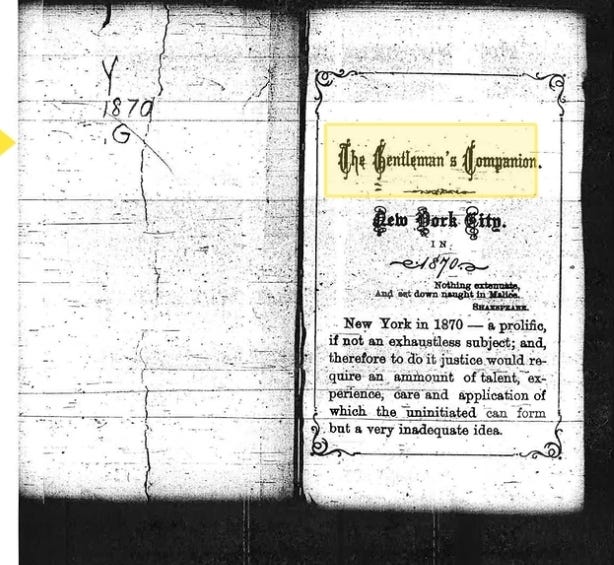
The authors provide a thoughtful thesis of intent: “We don’t intend to tell the reader where the Central Park is, the Croton Aqueduct, the New Court House […] but we propose to acquaint him with locations and with facts, a knowledge of which he could not procure elsewhere […] When we impart information that is not generally known, even to old denizens of the city, and give him an insight into the character and doings of people whose deeds are carefully screened from public view; when we describe their houses and give their locations, we supply the stranger with information of which he stands in need. We supply a void that otherwise must remain unfilled.”
Yes, we all know which void this refers to.
Revel in the layers of guile and snark. This book is a jewel in which those in on the bacchanalian joke find themselves before a feast of carefully scrutinized debauchery. The authors rightfully assume their reader will never desire to visit the aforementioned houses. He is, no doubt, “a member of the Bible Society” and a bright, shining light. No, the authors write from the purest commitment to warning the good reader, so that he might avoid these houses during his visit to New York.
Published in 1870, just three years prior to the Comstock Act, there exists a world in which this very text sent Anthony Comstock into a tizzy. Imagine, if you will, the balding U.S. postal inspector with characteristic verbose mutton chops, knickers in a twist, reading these very words as they arrived across his desk.
I shall now turn to the matter of the houses themselves. Broken down by neighborhood, the author provides a great many of them across 19th-century New York City. From public houses to boarding houses, this elucidative guide offers more than enough information for the curious reader to begin.
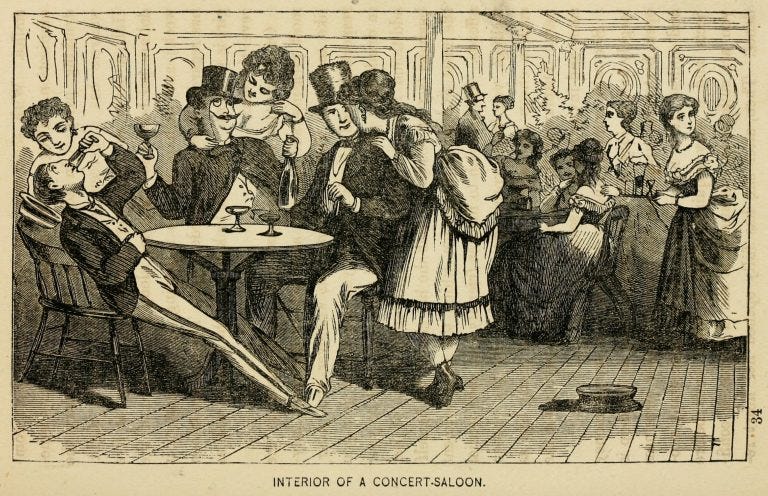
There are concert saloons, public houses, boarding houses, and private houses of assignation—each playing a role in the landscape of New York City’s vice districts. Establishments of both low and high rate are included, the latter described as appealing and “conducted in a quiet and orderly manner.”
Miss Emma Benedict’s house at 84 W. Houston Street is “arranged in the first style, while the bewitching smiles of the fairy-like creatures who devote themselves to the services of Cupid are unrivaled by any of the fine ladies who walk Broadway in silks and satins.”
But be warned of the third-rate establishments, such as the house of assignation kept by Miss Hattie Taylor of No. 111 Spring Street. “It is patronized by roughs and rowdies and gentlemen who turn their shirts wrong side out when the other side is dirty.” You would do best not to consort with people who do not do laundry. They are trouble, and likely carry many other kinds of grime beyond a few shirt stains. Still, No. 111’s colorful description will no doubt warrant clientele, as it is better to receive scathing remarks than to be utterly inconsequential, as is house No. 101, which is “of the third class and contains nothing worthy of attention.”
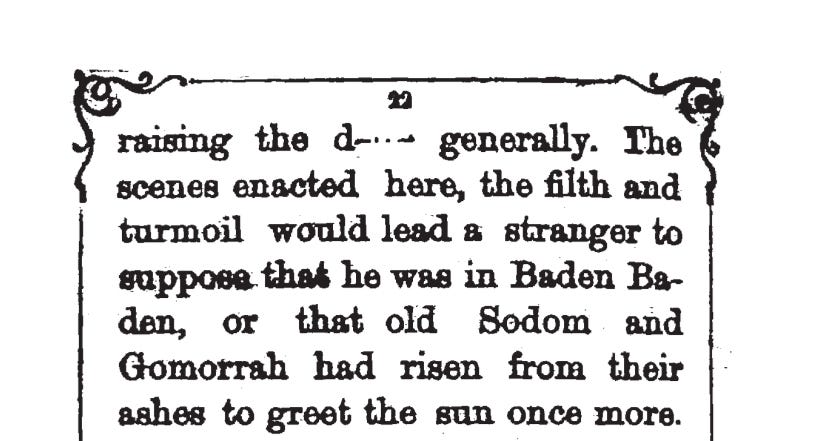
There are several houses best avoided due to the disposition of their occupants.
Laura Howard’s parlor at No. 16 East Thirteenth Street has six lady boarders, “but no interest whatever attaches to this house. Some of its visitors have asserted that its inmates are of a snobbish disposition.” Birtie White at No. 140 West Sixteenth Street has a sulky temper, and Miss Fanny Phippany’s landlady is “of a very selfish disposition, and the servants are very disagreeable.”
But, dearest reader, for those with tastes for finery, be gladdened, for there are many such options within New York City’s more refined brothels. Venture to West Twenty-Fifth Street, to house No. 105, kept by Mrs. Kate Woods of the Hotel de Wood. This brownstone is “furnished throughout with the most costly and newest improvements.” She boasts oil paintings that cost $10,000, rosewood furniture, Parisian figures, and massive mirrors. The overall furnishing cost $70,000, and her ladies are of rare and personal attractions. The merry laughs of the fun-loving ladies at No. 129 West 26th Street resound throughout the entire first-rate and magnificent palace.
Those more inclined toward the strange and exhilarating might benefit from a visit to No. 127 West 26th Street. Rumor has it that a bear is kept in the cellar, though there is little else attractive about the place.
And finally, for those with safety top of mind, one might consider attending Mrs. Lizzie Goodrich’s house at No. 128 West 27th Street. Not only is Mrs. Lizzie a dashing brunette, with lady boarders “whose cheerful disposition tends to drive away the blues,” but there is also “a regular physician attached to this house, and every attention is shown to its visitors.”
A jovial and revealing read, I highly recommend A Gentleman’s Companion: New York City (1870) as a rare window into New York City’s history of vice, sex work, and hidden social worlds. It survived Comstock’s obsession with rooting out vice and breathes life into a time when the options for the fairer sex were limited. Preserved in these scant pages are the names of a few entrepreneurial women who made the best of a system determined to extort and control them.
https://digitalcommons.unl.edu/etas/91/ A Gentleman’s Companion: New York City
https://archive.nytimes.com/www.nytimes.com/interactive/2011/01/26/nyregion/gentleman.html - dens of Iniquity